
GM conversion to wartime production
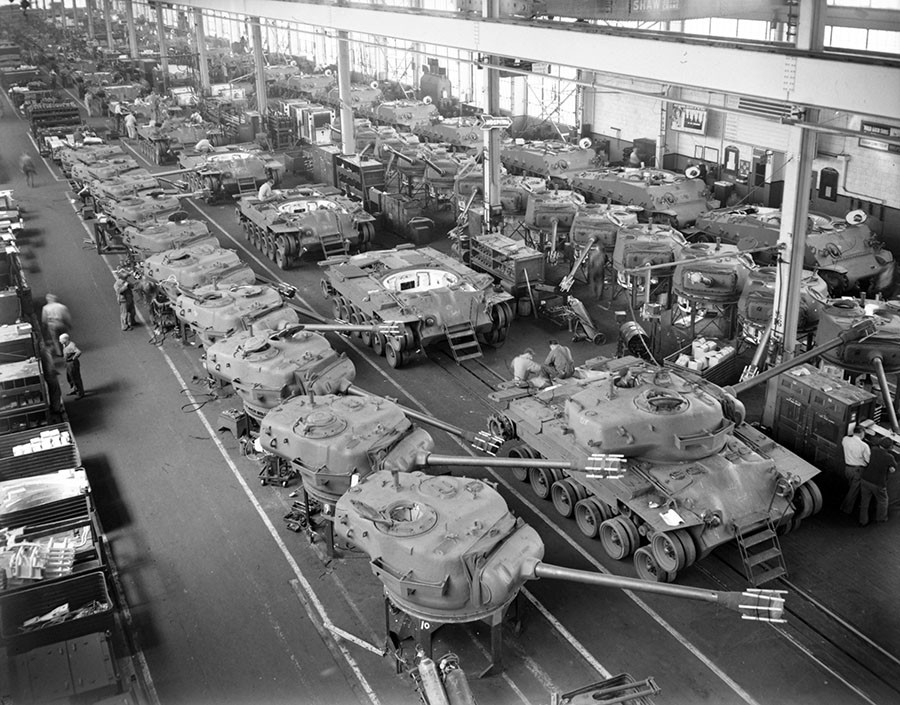
General Motors converted to war production in just 29 days after ending civilian lines and ultimately contributed 10 percent of all US war production.
General Motors started up war production only twenty-nine days after ending the civilian line. In the end it would contribute 10 percent of all U.S. war production. The others weren’t far behind.
It was one of the great success stories of World War II. In 1939 the U.S. Army had barely 15,000 vehicles. In the spring of 1941, it was already looking to acquire a quarter million before Pearl Harbor raised everyone’s calculations. Not counting tanks, by the end of 1942 the Army would be the customer for 800,000 vehicles of some 330 different types. By 1945 the number would grow to 3.2 million—one vehicle for every 2.75 Americans in an Army uniform. Meantime the Wehrmacht, the model of modern warfare in 1940, still relied on horse-drawn transport. “When Hitler put his war on wheels,” General Brehon Somervell said at the end of the war, “he ran it straight down our alley.”
Effect on Michigan’s Economy
That concession [1] persuaded the aviation people to sign on to Knudsen’s plan, as well. In the end it would pay off handsomely. Although Michigan held only 4 percent of the country’s population, it would ultimately supply 10 percent of all major war contracts. By D-day almost one out of every five Michigan residents was involved in war work, and 70 percent of that work was confined to the four counties around metro Detroit, the heart of the auto industry. General Motors alone would make 10 percent of everything America produced during World War II, including thousands of aircraft engines, hundreds of different parts for Boeing, Martin, and North American, and entire airplanes for Grumman.

[1] agreement by automobile executives to suspend all annual model changes for automobiles
Fridges and jukeboxes
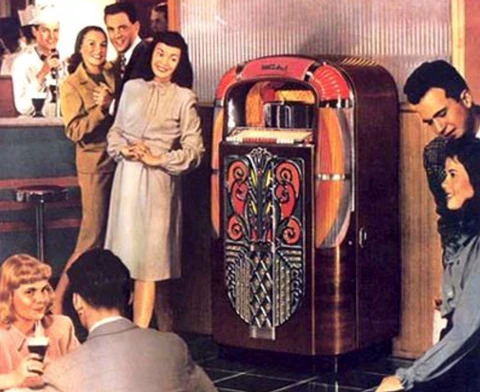
Frigidaire, a refrigerator manufacturer, started producing .30-caliber machine guns. Rock-Ola, a jukebox maker, contracted to produce M1 carbines alongside typewriter companies and hardware manufacturers.
Soon Harrington brothers had other visitors, like the War Production Board’s local director and a reporter from Time magazine. “I don’t think they knew what they were getting into when they started,” the WPB man told the reporter, “but they had the nerve to make a success of it.”16
That might have been the motto of every American business, large and small, in World War II. There was Frigidaire, enlisted to manufacture .30-caliber machine guns, and Rock-Ola, the Chicago jukebox maker that was drawn into a contract to make M1 carbines alongside Underwood the typewriter company, National Postal Meter, Quality Hardware, and IBM. On the upper end of the scale, there was Ex-Cello of Detroit, which made thread-grinding machines for turning the millions of screws for military hardware from airplanes to trucks and towed artillery; Okonite of New Jersey, which insulated thousands of miles of electrical wiring; and Missouri Valley Bridge and Iron and Chicago B&I, which built hundreds of Land Ship Tanks at yards they created in Evansville, Indiana, the so-called prairie shipyards where ex-farmhands built LSTs to float down to the Mississippi and New Orleans for service overseas.17
Dam construction to Liberty ships
One example of how Henry Kaiser applied expertise from dam construction to shipbuilding was the use of large gantry cranes. When building his shipyards, such as the Todd California Shipbuilding Corporation in Richmond, California, Kaiser’s team, led by Clay Bedford, needed large cranes to hoist prefabricated sections of the ships into place:
When finished, the yard had seven shipways, each 87½ feet wide and 425 feet long. North of the shipways was a massive steel-framed building housing the plate shop and assembly bay, as well as a large open area where preassembled parts could be moved and stored until hoisted into place. To do the hoisting, each shipway was serviced by cranes that moved along steel tracks set on either side of each slipway, so that the crane could swing from one slipway back to another. Gantry cranes of that size were in short supply in Depression-era America, so Bedford arranged for cranes he had used building Grand Coulee Dam to be dismantled and shipped west.5 Until now the model for American shipbuilding had been the steel industry. Kaiser and his team would introduce a new model: big-time construction. In so doing, they would revolutionize shipbuilding not just in America but around the world.
 Real Fids